Fileteado in Barcelona: the Ferlandina 26 sign, hand-painted by Adrián
Above our door on Carrer de Ferlandina 26 there's a piece of Buenos Aires in the middle of El Raval. Want something like it for your bar, shop or home? Adrián takes commissions.
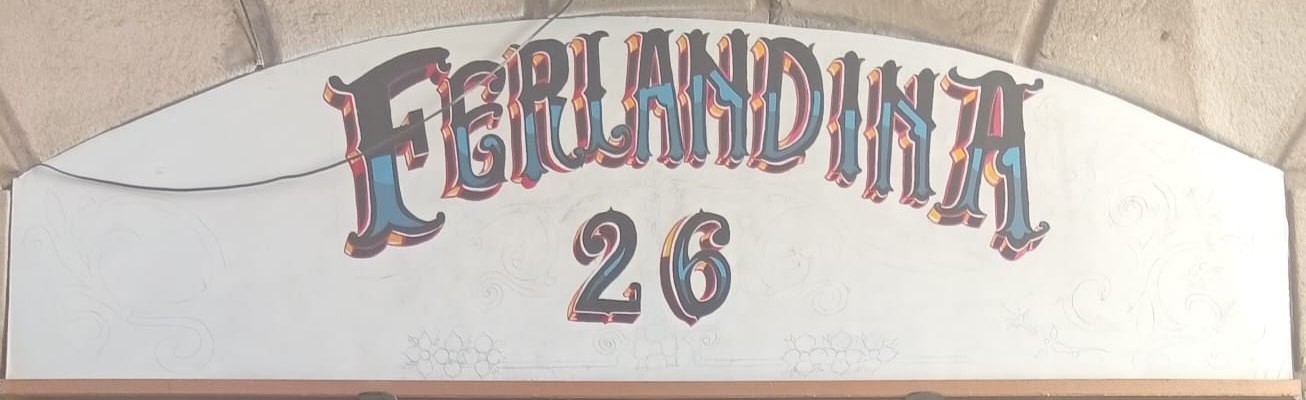
Our sign up close
The lettering fills the white arch above the entrance and gently follows its curve. The tall, narrow capitals of FERLANDINA are dark and filled with lines of sky blue and red. Black shadows along the edges make them pop, and the points and flourishes at the ends give them the playful look typical of fileteado. Below is the number 26 in the same style; around it you can make out fine traces of scrolls and flowers.
Sky blue and white are no accident: they are the colours of the Argentine flag.
Adrián is one of the many artists who have already made a valuable contribution to the Ferlandina 26 cultural association in Barcelona's Raval.
Looking for a fileteado artist in Barcelona?
Would you like a sign, a shopfront lettering or a painting in Argentine fileteado? Message Adrián directly on Instagram and tell him what you have in mind, the size and where it will go. To see his work in person, stop by Carrer de Ferlandina 26 and look up.
Commission Adrián on Instagram ↗
Instagram: @jolvhh
From horse carts to city buses
Fileteado was born in the late 19th century in Buenos Aires, in the workshops where horse-drawn carts were built. Many of the craftsmen were Italian immigrants. The carts were painted plain grey; little by little the painters began to decorate edges and panels with thin ornamental lines – «filetes». Hence the name.
The thin lines soon grew into ornaments, flowers and lettering. In the 20th century the art moved onto lorries and above all onto the «colectivos», the city buses of Buenos Aires: every owner wanted the finest vehicle on the route.
In the 1970s the city banned the decoration on buses because it made route numbers and destinations hard to read. So fileteado moved onto shop signs, cafés, tango halls and canvases. Today it is cultural heritage of the City of Buenos Aires and, since 2015, on UNESCO's list of Intangible Cultural Heritage.
The technique: patience, symmetry and a very long brush
Fileteado is painted entirely by hand, usually with enamel paints on wood, sheet metal or glass. The key tool is a brush with extremely long, thin hairs: it holds plenty of paint and allows long, even lines in a single stroke. This is how a piece like our sign comes about:
- Sketch on paper. The ornaments are almost always symmetrical: one half is drawn and the paper folded to mirror the other.
- Transfer. The lines of the sketch are pricked with a needle, then chalk or pigment powder is dabbed through the holes – an old stencilling technique.
- Base colours. The areas are filled in strong, rich colours.
- Shading. In several steps, from dark to light, leaves and letters gain volume and look almost three-dimensional.
- Highlights. Fine light strokes make the shapes shine.
- Outlines. Finally, black or dark lines frame everything – the actual filetes.
- Varnish. A clear varnish protects the painting from weather and time.
The lettering is the hardest part: letters are decorated, shaded and often linked with flourishes. Exactly what you see in «Ferlandina» above our door.
The visual language
Fileteado has a fixed vocabulary. Once you know it, you read every sign a little differently:
- Acanthus leaves and spirals – the basic ornament, borrowed from European decorative art.
- Flowers and birds – joy of life and beauty.
- Dragons – strength and protection.
- Horseshoes – good luck, a nod to the days of the horse carts.
- Sky-blue and white ribbons – the colours of the Argentine flag.
- Sayings – proverbs, jokes or declarations of love in ornate lettering.
Add strict symmetry, bright colours and hardly any empty space.
From Buenos Aires to El Raval
Fileteado is an immigrants' art: European ornament reinvented in Argentina. It fits that it now hangs above a door in El Raval – few Barcelona neighbourhoods are as many-voiced and as open to art from everywhere.
The street name has a story too. «Ferlandina» is a corrupted form of «Fernandina»: the Dukes of Fernandina once had a palace here. Adrián has now dressed that old name in Buenos Aires style.

FAQ
Where can I commission fileteado in Barcelona?
For example from Adrián, the artist who painted the Ferlandina 26 sign. Message him on Instagram at @jolvhh with your idea: sign, lettering or painting, size and location.
Where can I see fileteado in Barcelona?
At Carrer de Ferlandina 26 in El Raval, two minutes from MACBA. The sign is above the door and can be seen from the street at any time.
What is Argentine fileteado?
An ornamental painting style born in Buenos Aires in the late 19th century, with fine lines, scrolls, flowers and shaded lettering. Since 2015 it has been UNESCO Intangible Cultural Heritage.
Look up
Next time you visit, take a second look above the door: where are the spirals mirrored? How do the letters get their shine? How many shades are in a single leaf? The sign isn't just our name – it's a small piece of cultural heritage, hand-painted on Carrer de Ferlandina.